60 vs. 72 vs. 84 Month Car Loan: Total Cost of $40,000 at 7%
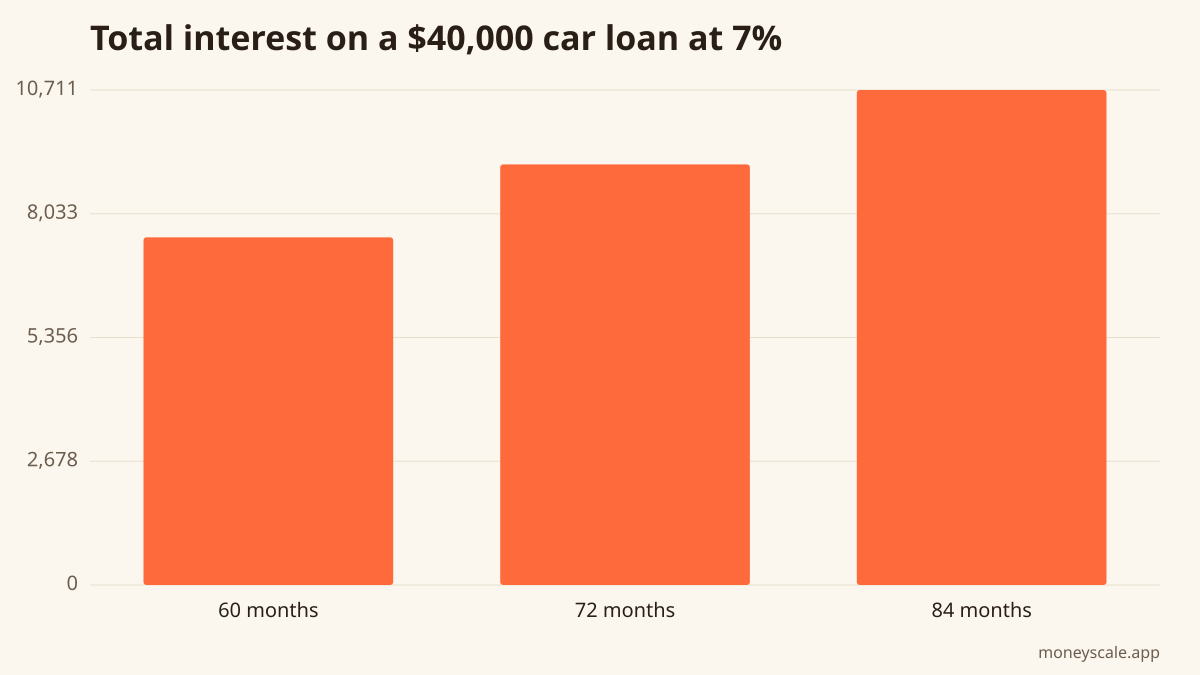
A $40,000 car loan at 7% costs $7,523 in interest over 60 months and $10,711 over 84. The 84-month loan still has $30,488 left on it after 24 payments.

Written with AI assistance; every figure is checked against our calculators and primary sources, and reviewed by Ethan Ginsberg before publishing.
The bottom line
On a $40,000 loan at 7%, the 84-month term costs $604 a month and $10,711 in interest, vs. $792 a month and $7,523 in interest over 60 months.
On a $40,000 car loan at 7%, an 84-month term costs $3,188 more in interest than a 60-month term. In exchange, the payment drops by about $188 a month, but the balance falls so slowly that you would still owe $30,488 after two years of payments.
How the payment on a $40,000 loan is calculated
Month one of a $40,000 loan at 7% carries $233.33 of interest, no matter the term. The lender divides the annual percentage rate (APR, the yearly cost of borrowing including certain fees) by 12, which gives 0.5833% a month, and applies it to the full balance.
Say Jordan finances $40,000 at 7% this fall. Each payment covers that month's interest first, and the rest pays down the principal, the amount still owed. The amortization formula, the math that turns a loan into equal monthly payments, finds the one payment that brings the balance to zero on the last month.
Payment = Loan × r ÷ (1 − (1 + r)^−n)
In plain words, r is the monthly rate (0.07 ÷ 12) and n is the number of payments. More months make the bottom of that fraction larger, so each payment shrinks and pays down the balance more slowly.
On 60 months, Jordan's payment is $792.05. In month one, $233.33 goes to interest and $558.72 goes to principal. On 84 months, the payment drops to $603.70, and only $370.37 of the first payment reduces the balance, about two-thirds as much. Swap in your own price, rate, and term in the auto loan payment and interest calculator.
How much more does a 72- or 84-month car loan cost?
Slower paydown keeps interest running on a bigger balance for longer, so total interest climbs with every 12 months added to the term. This table shows the payment, total interest, and total paid for each term on the same $40,000 at the same 7%.
| Term (months) | Monthly payment ($) | Total interest ($) | Total paid ($) |
|---|---|---|---|
| 60 | 792.05 | 7,523 | 47,523 |
| 72 | 681.96 | 9,101 | 49,101 |
| 84 | 603.70 | 10,711 | 50,711 |
Going from 60 to 72 months lowers the payment by $110.09 and adds $1,578 in interest, while the next 12 months save only $78.26 a month and add another $1,610.
Over the first 60 months, the 84-month loan leaves Jordan with $11,301 more cash ($188.35 × 60). Then 24 more payments of $603.70 come due, $14,489 in total. The gap between those two figures is the $3,188 of extra interest.
In round numbers, Jordan is choosing between $792 a month for five years and $604 a month for seven.
What do you still owe at month 24 and month 36?
After 24 payments, the 84-month loan still has $30,488 left on it, nearly $5,000 more than the 60-month loan. Cars lose value while you pay, and owing more on the loan than the car is worth is called negative equity.
The table below sets each balance against an invented depreciation path: a $40,000 car worth $28,000 after two years and $24,000 after three. Real values depend on the model, mileage, and used-car prices at the time.
| Term (months) | Owed at month 24 ($) | Equity vs. $28,000 value ($) | Owed at month 36 ($) | Equity vs. $24,000 value ($) |
|---|---|---|---|---|
| 60 | 25,652 | +2,348 | 17,690 | +6,310 |
| 72 | 28,479 | −479 | 22,086 | +1,914 |
| 84 | 30,488 | −2,488 | 25,211 | −1,211 |
At month 36, the 84-month loan is still underwater by $1,211, while the 60-month loan has $6,310 of equity on the same car.
Negative equity shows up at two moments. If the car is totaled or stolen, insurance generally pays its market value, not the loan balance, and you owe the difference. If you trade the car in early, the shortfall has to be paid in cash or added to the next loan.
Do longer car loans carry higher interest rates?
Some lenders price longer terms at a higher APR, and when they do, the tables above understate the real gap. The Consumer Financial Protection Bureau's auto-loan pages, as of Oct. 23, 2026, note that a longer term lowers the monthly payment but raises the total cost, and that a longer loan puts you at risk for negative equity. A 2017 report from the same agency found that six-year loans cost more and tend to go to borrowers with lower credit scores.
The Federal Reserve's G.19 Consumer Credit release, published monthly, reports average rates on 60-month and 72-month new-car loans at commercial banks, updating those rows once a quarter. Jordan's 7% is a round number chosen for illustration, and a dealer's quoted APR can be read against the G.19 averages.
Suppose the 84-month offer comes at 8% instead of 7%, a bump of one percentage point. The payment becomes $623.45 and total interest rises to $12,370. Compared with 60 months at 7%, that saves $168.60 a month and costs $4,847 more in interest.
How add-ons and a trade-in balance get financed
Anything added to the deal becomes part of the amount financed, the total the loan pays out, and collects interest for the full term. The Federal Trade Commission's guide "Financing or Leasing a Car" notes that add-ons such as service contracts are optional, that a dealer-arranged rate may include an amount the dealer keeps, and that the rate can be negotiated.
Say Maya agrees on a $35,000 price, taxes and fees included. She adds a $2,000 service contract. Her trade-in is worth $12,000, but she still owes $15,000 on it, so $3,000 of old loan gets rolled into the new one. Her amount financed comes to $40,000, the same figure as Jordan's.
Of that $40,000, $5,000 pays for things other than the new car. At 7% over 84 months, that $5,000 adds $75.46 to each payment and $1,339 in interest. Maya also starts the loan owing $5,000 more than the agreed price of the car, before any depreciation.
The buyer's order, the dealer's itemized sales sheet, lists the price, fees, and add-ons. On the retail installment contract, the loan agreement signed at the dealer, the "amount financed" line shows the total, and itemized lines below it show the add-ons and any payoff of the old loan.
The input that moves the total most
Of the three levers on this $40,000 loan, the term moves total interest most: going from 60 to 84 months adds $3,188. A one-point higher APR on the 84-month loan adds another $1,659, and $5,000 of rolled-in extras adds $1,339. Each $1,000 financed at 7% for 84 months costs about $268 in interest.
Those levers stack, which is how a $40,000 deal with a long term, a higher rate, and rolled-in balances can end up costing well above the $10,711 in the table. Enter the amount financed from the buyer's order, the APR, and each term in the auto loan payment and interest calculator to see payment, total interest, and balance for all three terms on your own contract.
Run your numbers
Plug your own figures into the Auto Loan calculator and see your specific outcome.
Open Auto LoanSources
Related reads
Saver's Match 2027: Who Gets Up to $1,000 for Retirement
The Saver's Match starts with 2027 contributions: 50% of up to $2,000 you save, or $1,000 a year. It goes into a retirement account, not your tax refund.
Read itWill a Raise Put Me in a Higher Tax Bracket? The $5,000 Math
A raise into the 22% bracket taxes only dollars above the line, per 2026 IRS brackets. See how a $5,000 raise turns into $3,767.50 of take-home pay.
Read itStudent Loan Autopay Discount Jumps to 1% on July 1, 2026
The federal autopay interest-rate discount rises from 0.25 to a full 1 percentage point on July 1, 2026. Here's how it works, who qualifies, and what one point does to total interest.
Read itFederal Student Loan Interest Rates for 2026–27: How the July 1 Rate Is Set
The new fixed rates for federal Direct loans disbursed July 1, 2026–June 30, 2027, the Treasury-plus-add-on formula that sets them, and how one rate point changes a payment.
Read it
Money Scale Weekly
Money Scale Weekly — one chart, one idea, every week.
A short, plain-English read on saving, investing and compounding, with the numbers run for you. Free.
Free. One email a week. No spam — unsubscribe in one click.
Money Scale is free to read and free to use — no paywall, no account, no selling your data. Hosting and research still cost money, so if this was worth your time you're welcome to buy us a coffee. Never required.