Will a Raise Put Me in a Higher Tax Bracket? The $5,000 Math
A raise into the 22% bracket taxes only dollars above the line, per 2026 IRS brackets. See how a $5,000 raise turns into $3,767.50 of take-home pay.

Written with AI assistance; every figure is checked against our calculators and primary sources, and reviewed by Ethan Ginsberg before publishing.
The bottom line
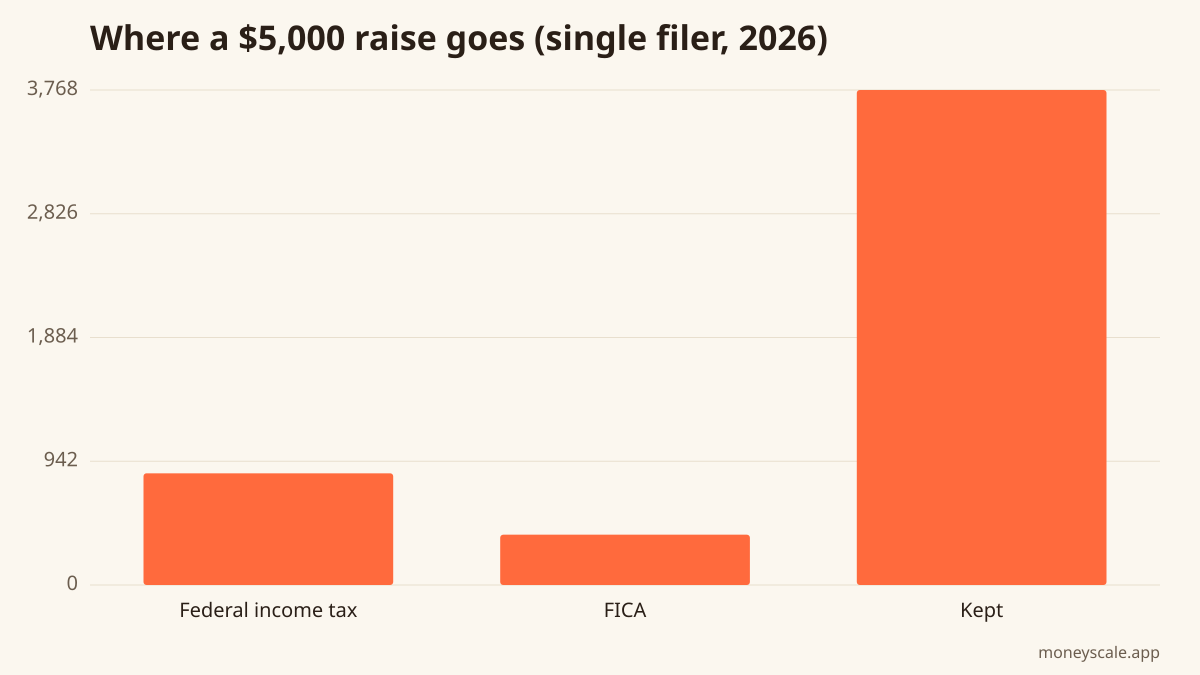
A single filer who gets a $5,000 raise and crosses into the 22% bracket in 2026 pays $850 more in federal income tax and keeps $3,767.50 after federal income tax and FICA.
A raise into the 22% bracket can't shrink your take-home pay, because only the dollars above the bracket line are taxed at 22%. Under 2026 brackets from the Internal Revenue Service (IRS), a single filer whose $5,000 raise crosses that line keeps $3,767.50 after federal income and payroll taxes. The IRS resets these lines each fall for the next year.
The math on a $64,000 salary and a $5,000 raise
Maya, an invented example, is single and earns $64,000, and her new offer pays $69,000 for all of 2026. She takes the standard deduction and has no pre-tax deductions.
Her first step is subtracting the standard deduction, a flat amount of income the IRS doesn't tax. The IRS's Revenue Procedure 2025-32, released Oct. 9, 2025, sets the 2026 standard deduction at $16,100 for single filers, $24,150 for heads of household, and $32,200 for married couples filing jointly. Maya's taxable income goes from $47,900 to $52,900.
For a single filer in 2026, the 12% bracket ends at $50,400 of taxable income. So her raise splits in two. Half of it, $2,500, fills the rest of the 12% bracket and costs $300 in tax. The other $2,500 lands in the 22% bracket and costs $550. Her federal income tax rises from $5,500 to $6,350, an increase of $850.
Payroll tax works differently. IRS Publication 15 (Circular E), Employer's Tax Guide, for 2026 sets Social Security tax at 6.2% and Medicare tax at 1.45% of wages. Together they make up Federal Insurance Contributions Act (FICA) tax, and they hit every dollar of the raise with no deduction. Maya's FICA goes from $4,896 to $5,278.50, or $382.50 more.
The table below follows her raise from gross pay to what she keeps, before any state tax.
| Line | Before raise ($) | After raise ($) | Change ($) |
|---|---|---|---|
| Gross salary | 64,000 | 69,000 | +5,000 |
| Standard deduction | 16,100 | 16,100 | 0 |
| Taxable income | 47,900 | 52,900 | +5,000 |
| Federal income tax | 5,500 | 6,350 | +850 |
| FICA at 7.65% | 4,896 | 5,278.50 | +382.50 |
| Pay after these taxes | 53,604 | 57,371.50 | +3,767.50 |
FICA alone adds $382.50, more than the $300 of income tax on the half of the raise that stayed in the 12% bracket.
Maya keeps $3,767.50 of her $5,000, about 75 cents of every raise dollar. Spread over 26 biweekly paychecks, that's roughly $144.90 more per check before state tax, health premiums, or retirement contributions. Swap in your own salary and raise in the take-home pay calculator.
Why a $60,000 salary still sits in the 12% bracket
A single filer with the standard deduction and no pre-tax deductions reaches the 22% bracket only above $66,500 of gross pay in 2026 ($16,100 plus $50,400). For a married couple filing jointly, the line is $133,000. Bracket thresholds apply to taxable income, not salary.
If you earn $60,000 and get a $5,000 raise, your taxable income moves from $43,900 to $48,900. Every raise dollar stays at 12%. Federal income tax rises from $5,020 to $5,620, an increase of $600, and FICA adds $382.50. You keep $4,017.50.
Pre-tax deductions move the line further. Contributions to a traditional 401(k), an employer-sponsored retirement savings plan, lower the wages subject to income tax. The Department of Labor's guide to types of retirement plans lists the 401(k) as a defined contribution plan, one where your balance depends on contributions and investment returns.
If Maya sent $2,500 of her raise into a traditional 401(k), her income-tax wages would be $66,500 and her taxable income would land at $50,400, the top of the 12% bracket. Her income tax would be $5,800, only $300 more than before the raise.
That 401(k) money still owes FICA. Elective deferrals, the pay you route into a 401(k), stay subject to Social Security and Medicare tax, so the $382.50 payroll tax increase doesn't shrink.
What are the 2026 federal tax brackets?
Seven federal income tax rates apply in 2026, from 10% to 37%, under the same revenue procedure. The table shows the taxable-income bands for the two most common filing statuses.
| Rate | Single, taxable income ($) | Married filing jointly, taxable income ($) |
|---|---|---|
| 10% | 0 to 12,400 | 0 to 24,800 |
| 12% | 12,401 to 50,400 | 24,801 to 100,800 |
| 22% | 50,401 to 105,700 | 100,801 to 211,400 |
| 24% | 105,701 to 201,775 | 211,401 to 403,550 |
| 32% | 201,776 to 256,225 | 403,551 to 512,450 |
| 35% | 256,226 to 640,600 | 512,451 to 768,700 |
| 37% | Over 640,600 | Over 768,700 |
Joint thresholds are double the single ones at every line but the top: the 37% rate starts at $768,700 for couples, only 1.2 times the $640,600 single threshold.
Each rate applies only to the slice of income inside its band. A single filer with $52,900 of taxable income pays 10% on the first $12,400, 12% on the next $38,000, and 22% on the last $2,500.
What's the difference between marginal and effective tax rate?
After her raise, Maya's marginal rate is 22%, but her effective federal income tax rate is 9.2%. Her marginal rate is the tax on her next dollar of income, and her effective rate is total income tax divided by gross pay.
The table compares both measures before and after her raise.
| Measure | Before raise | After raise |
|---|---|---|
| Marginal federal income tax rate | 12% | 22% |
| Effective federal income tax rate (tax ÷ gross pay) | 8.6% | 9.2% |
| Marginal rate including 7.65% FICA | 19.65% | 29.65% |
Her marginal rate jumps 10 percentage points, but her effective rate moves only 0.6 points.
Worry about raises comes from applying the top rate to every dollar. If 22% applied to all $52,900 of Maya's taxable income, her tax would be $11,638, nearly double the correct $6,350. Under that wrong model, the raise would cost more than it paid. Under the real brackets, only the $2,500 above $50,400 of taxable income pays 22%.
Why doesn't my paycheck match the bracket math?
IRS Publication 15-T, Federal Income Tax Withholding Methods, for 2026 tells employers to annualize each paycheck, apply the entries on your Form W-4, the withholding certificate you give your employer, figure the tax, and divide it back across pay periods. Withholding is a prepayment, and your tax return settles the difference.
A mid-year raise creates one gap. From the first raised paycheck on, your withholding is figured as if you earned the new salary all year. Your real annual income is lower than that, so total withholding usually runs a bit high, and the extra comes back as a refund.
Bonuses add a second gap. Employers may withhold a flat 22% of federal income tax on bonuses and other supplemental wages under the same employer's guide. That 22% is a withholding rate, not your bracket, and a filer in the 12% bracket gets the excess back at filing time.
FICA changes shape at high pay. The Social Security Administration sets the 2026 contribution and benefit base, the cap on wages taxed for Social Security, at $184,500. A raise earned entirely above that cap costs only the 1.45% Medicare tax, or 2.35% on wages above $200,000, where the 0.9% Additional Medicare Tax applies.
State income tax, health premiums, and retirement contributions also move the net figure on each check.
When will the IRS release 2027 tax brackets?
Each fall, the IRS publishes the next year's inflation adjustments in a revenue procedure announced in the IRS newsroom; the 2026 version came out Oct. 9, 2025. Every number above is an official 2026 figure, and projections from other publishers aren't official until the IRS posts its own.
Once released, the 2027 brackets will apply to income earned starting Jan. 1, 2027, and to returns filed in 2028. The IRS's federal income tax rates and brackets page lists the bands for the current year. When the new numbers post, the method stays the same: subtract the standard deduction, find where your taxable income crosses a line, and apply the higher rate only above it.
How far your taxable income sits from the nearest bracket line moves the result most, and pre-tax deductions can shift that distance by thousands of dollars. Enter your salary, raise, and 401(k) contributions in the take-home pay calculator to see how many of your raise dollars land above $50,400 of 2026 taxable income.
Run your numbers
Plug your own figures into the Take-Home Pay calculator and see your specific outcome.
Open Take-Home PaySources
- IRS Revenue Procedure 2025-32 (2026 inflation adjustments)
- IRS, Federal income tax rates and brackets
- IRS Publication 15-T, Federal Income Tax Withholding Methods
- IRS Publication 15 (Circular E), Employer's Tax Guide
- IRS Newsroom
- Social Security Administration, Contribution and Benefit Base
- U.S. Department of Labor, Types of Retirement Plans
Related reads
Social Security Wage Base 2027: Tax Stops at $192,300
The 2027 Social Security wage base is $192,300, up from $184,500 in 2026. See when the 6.2% tax stops and how two-job workers get excess tax back.
Read it60 vs. 72 vs. 84 Month Car Loan: Total Cost of $40,000 at 7%
A $40,000 car loan at 7% costs $7,523 in interest over 60 months and $10,711 over 84. The 84-month loan still has $30,488 left on it after 24 payments.
Read itWhy your mortgage rate is higher than the 7.32% average
Freddie Mac's 30-year average fell to 7.32% on Oct. 22, 2026. On a $300,000 loan, a 7.82% quote costs $103 more a month. See what moves your quote.
Read itSaver's Match 2027: Who Gets Up to $1,000 for Retirement
The Saver's Match starts with 2027 contributions: 50% of up to $2,000 you save, or $1,000 a year. It goes into a retirement account, not your tax refund.
Read it
Money Scale Weekly
Money Scale Weekly — one chart, one idea, every week.
A short, plain-English read on saving, investing and compounding, with the numbers run for you. Free.
Free. One email a week. No spam — unsubscribe in one click.
Money Scale is free to read and free to use — no paywall, no account, no selling your data. Hosting and research still cost money, so if this was worth your time you're welcome to buy us a coffee. Never required.