Saver's Match 2027: Who Gets Up to $1,000 for Retirement
The Saver's Match starts with 2027 contributions: 50% of up to $2,000 you save, or $1,000 a year. It goes into a retirement account, not your tax refund.

Written with AI assistance; every figure is checked against our calculators and primary sources, and reviewed by Ethan Ginsberg before publishing.
The bottom line
The Saver's Match deposits 50 cents for every dollar you contribute, up to $1,000 a year per person, starting with 2027 contributions.
The Saver's Match, which starts with 2027 contributions, adds up to $1,000 a year to a lower- or moderate-income worker's retirement account. Under federal law, getting the full amount takes $2,000 of your own contributions, and the deposit arrives only after you file that year's tax return.
The math on a $2,000 contribution
Maya, an invented example, is 24 and earns $22,000 in her first full-time job. During fall open enrollment she sets her 2027 traditional 401(k) contribution at about $77 per paycheck, which totals $2,000 over 26 paychecks.
Her employer matches 50% of her contributions on the first 6% of pay, worth $660 a year. IRS Notice 2026-48 explains that modified adjusted gross income (MAGI) for the Saver's Match adds pre-tax retirement contributions back to the adjusted gross income (AGI) on Form 1040, so traditional contributions don't lower it. Her AGI is $20,000, but her MAGI stays at $22,000.
That's $1,500 above the $20,500 threshold for single filers, or one-tenth of the way through the $15,000 phase-out range, where the match shrinks to zero. Her rate drops from 50% to 45%, so the Saver's Match pays $900 on her $2,000.
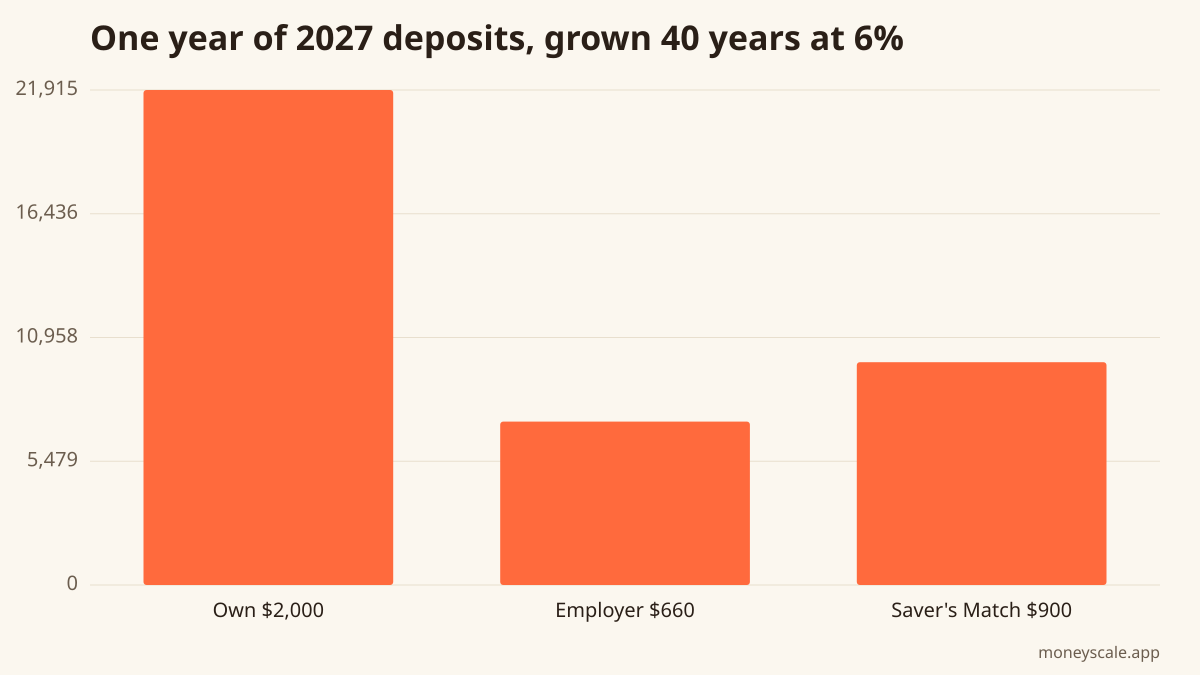
This table gives each deposit 40 years to grow at an assumed 6% annual return, compounded monthly. One column shows a single year's money, and the other repeats the same deposits every year, spread monthly. The Securities and Exchange Commission's compound interest calculator, set to monthly compounding, runs the same kind of projection.
| Money going in | Amount per year ($) | One year's deposit at age 65 ($) | Every year's deposits at age 65 ($) |
|---|---|---|---|
| Maya's own contributions | $2,000 | $21,915 | about $332,000 |
| Employer match | $660 | $7,232 | about $110,000 |
| Saver's Match | $900 | $9,862 | about $149,000 |
Maya's Saver's Match row beats her employer row in both columns, because a 45% rate on all $2,000 outruns a 50% rate capped at 6% of a $22,000 salary. Swap in your own salary, employer formula, and return in the 401(k) growth calculator.
Who qualifies for the Saver's Match?
Three personal tests carry over from the Saver's Credit, the tax credit the match replaces for retirement contributions after 2026. The Internal Revenue Service (IRS) lists them on its Retirement Savings Contributions Credit page: you must be 18 or older by the end of the tax year, not a full-time student, and not claimed as a dependent on someone else's return. That page counts you as a full-time student if you were enrolled full time during any part of five calendar months of the year.
Your own contributions are the next requirement. Contributions to a traditional or Roth individual retirement account (IRA) count. So do elective deferrals, the pay you send into a workplace plan, to a 401(k), 403(b), governmental 457(b), or Savings Incentive Match Plan for Employees (SIMPLE) IRA. Employer matching money doesn't count toward your $2,000.
Married couples filing jointly are tested together on income, but each spouse can receive up to $1,000. Owing zero federal income tax doesn't disqualify anyone, which is the biggest structural change from the old credit.
2027 income limits by filing status
Section 103 of the Setting Every Community Up for Retirement Enhancement (SECURE) 2.0 Act sets the income ranges below. Congress passed it as part of the Consolidated Appropriations Act, 2023, bill H.R. 2617. Each row shows where the full 50% rate ends and where the match reaches zero.
| Filing status | Full 50% match up to this MAGI ($) | Match reaches zero at this MAGI ($) |
|---|---|---|
| Married filing jointly or qualifying surviving spouse | $41,000 | $71,000 |
| Head of household | $30,750 | $53,250 |
| Single or married filing separately | $20,500 | $35,500 |
A single filer with $36,000 of MAGI gets nothing, while a head of household at that same income still qualifies for part of the match.
Below each range, the match pays 50 cents for every dollar you contribute. Inside the range, the 50% rate shrinks in a straight line, and the IRS rounds each reduction down to a whole percentage point. A single filer with $28,000 of MAGI sits halfway through the $15,000 range, so the rate falls to 25% and the maximum match is $500. A joint couple at $56,000 is also halfway, so each spouse can get up to $500.
Traditional and Roth contributions give the same result, because of that MAGI add-back. Deductible traditional IRA contributions are added back too. Had Maya made her $2,000 as Roth contributions, which come out of pay after tax, her MAGI would still be $22,000 and her match still $900. For many workers, Saver's Match MAGI runs higher than the AGI on their tax return.
The law indexes these dollar amounts to inflation for later years, so the IRS will publish new ranges for 2028 onward.
Which accounts can receive the deposit?
You designate the receiving account on your return: a 401(k), 403(b), or governmental 457(b) plan that agrees to accept the deposit, or a traditional IRA. Roth IRAs can't receive it, even though Roth contributions count toward your $2,000. Employers choose whether their plans accept these deposits, so having a 401(k) doesn't guarantee yours can take the money.
Someone who saves only in a Roth IRA still qualifies, since those contributions count. The deposit would need a separate home, such as a traditional IRA.
Is the Saver's Match taxed?
No tax is due when the match lands, because the law excludes it from your income for that year. It also doesn't count against your annual contribution limits. It's treated like a pre-tax 401(k) deferral, though, so the match and its growth are taxed as ordinary income when withdrawn.
IRS Tax Topic 557 covers the 10% additional tax on most withdrawals taken before age 59½, and that rule reaches the match too. A $900 match pulled out early can lose part of its value to income tax plus the extra 10%.
Earlier withdrawals can also shrink the match. As with the Saver's Credit, distributions taken during the testing period, which runs from two years before the tax year through your return's due date, reduce the contributions that count. Rollovers, which move money directly from one retirement account to another, don't count as distributions. A worker who contributes $2,000 in 2027 but cashed out $1,500 from an old 401(k) in 2026 would have $500 of qualifying contributions, worth a $250 match at the full rate.
What happens to the Saver's Credit in 2026?
Tax year 2026 is the last year the Saver's Credit applies to retirement-account contributions, and you claim it on Form 8880 with the return you file in 2027. The credit continues after 2026 for certain contributions to Achieving a Better Life Experience (ABLE) accounts, savings accounts for people with disabilities. Depending on income, the credit equals 50%, 20%, or 10% of up to $2,000 in contributions ($4,000 for joint filers), for a maximum of $1,000 per person.
Because the credit is nonrefundable, it can cut your tax bill to zero but not below. If you owe $300 in federal income tax, the credit is worth at most $300 to you, however much you saved. The match pays its full amount regardless of tax owed, though its income ranges stop below the top of the credit's 10% tier. The Form 8880 instructions list the 2026 income limits.
Workplace plan contributions count toward the 2026 credit only if they come out of paychecks dated on or before Dec. 31, 2026. IRA contributions for 2026 can still be made until the April 15, 2027, filing deadline.
Details still open before the 2028 filing season
As of Oct. 19, 2026, the Treasury Department and the IRS haven't finalized several mechanics. Open items include the form line for naming the receiving account, how plans signal that they accept deposits, how soon after filing the money arrives, and what happens if you name no eligible account. Draft forms and instructions for tax year 2027 are the documents that will settle those points.
For a single filer near the line, MAGI moves the result more than any other input. Every $1,500 above $20,500 removes 5 points from the 50% rate, or $100 from a full $1,000 match. Because pre-tax contributions are added back, a bigger traditional 401(k) deferral doesn't pull MAGI under the threshold. Run your 2027 contribution rate and employer formula through the 401(k) contribution calculator to see the balance those dollars could reach by age 65.
Run your numbers
Plug your own figures into the 401(k) Projection calculator and see your specific outcome.
Open 401(k) ProjectionSources
- IRS: Retirement Savings Contributions Credit (Saver's Credit)
- IRS: About Form 8880, Credit for Qualified Retirement Savings Contributions
- IRS: Topic No. 557, Additional Tax on Early Distributions from Retirement Plans
- Congress.gov: H.R. 2617, Consolidated Appropriations Act, 2023 (includes SECURE 2.0 Act)
- SEC Investor.gov: Compound Interest Calculator
Related reads
Mid-2026 Check: Are You on Pace to Max Out Your 401(k)?
A mechanical, no-advice walkthrough of the math that tells you whether your current 401(k) deferral hits the 2026 IRS cap by December 31.
Read it60 vs. 72 vs. 84 Month Car Loan: Total Cost of $40,000 at 7%
A $40,000 car loan at 7% costs $7,523 in interest over 60 months and $10,711 over 84. The 84-month loan still has $30,488 left on it after 24 payments.
Read itWill a Raise Put Me in a Higher Tax Bracket? The $5,000 Math
A raise into the 22% bracket taxes only dollars above the line, per 2026 IRS brackets. See how a $5,000 raise turns into $3,767.50 of take-home pay.
Read itSocial Security Wage Base 2027: Tax Stops at $192,300
The 2027 Social Security wage base is $192,300, up from $184,500 in 2026. See when the 6.2% tax stops and how two-job workers get excess tax back.
Read it
Money Scale Weekly
Money Scale Weekly — one chart, one idea, every week.
A short, plain-English read on saving, investing and compounding, with the numbers run for you. Free.
Free. One email a week. No spam — unsubscribe in one click.
Money Scale is free to read and free to use — no paywall, no account, no selling your data. Hosting and research still cost money, so if this was worth your time you're welcome to buy us a coffee. Never required.