Why your mortgage rate is higher than the 7.32% average
Freddie Mac's 30-year average fell to 7.32% on Oct. 22, 2026. On a $300,000 loan, a 7.82% quote costs $103 more a month. See what moves your quote.
Written with AI assistance; every figure is checked against our calculators and primary sources, and reviewed by Ethan Ginsberg before publishing.
The bottom line
On a $300,000 30-year loan, a 7.82% quote costs $2,164 a month in principal and interest, $103 more than the $2,061 payment at Freddie Mac's 7.32% average.
Freddie Mac's 7.32% weekly mortgage average describes borrowers with big down payments and excellent credit, so many personal quotes come in above it. A quote half a percentage point higher adds about $103 a month on a $300,000 loan. Credit score, down payment, discount points, loan type, and lock timing drive most of that gap.
What Freddie Mac's 7.32% average measures
Freddie Mac's Primary Mortgage Market Survey (PMMS), released Oct. 22, 2026, put the average 30-year fixed rate at 7.32%, down from 7.40% a week earlier. Freddie Mac posts a new reading every Thursday at noon ET.
That number is an average of loan applications, not a rate any lender posts. Since November 2022, the survey has been built from applications lenders submit through Loan Product Advisor, Freddie Mac's automated system for checking whether a loan meets its rules.
Freddie Mac's PMMS methodology notes narrow the pool further. Every loan in the average is conventional, meaning no government insurance or guarantee, and conforming, meaning the balance fits under the Federal Housing Finance Agency's yearly limit. The loans are fully amortizing, so scheduled payments clear the balance by the end of the term. Only home purchases count, and the borrowers put 20% down and have excellent credit.
Federal Reserve Economic Data (FRED), the Federal Reserve Bank of St. Louis's data site, republishes the same weekly figure as series MORTGAGE30US, with history back to 1971. Every point on that line carries the same 20%-down, excellent-credit assumptions.
The monthly cost of a higher quote on $300,000
Maya, an illustrative first-time buyer, is purchasing a $375,000 house with $75,000 down, so she borrows $300,000 on a 30-year fixed loan. At the 7.32% average, her monthly principal and interest comes to $2,061. Last week's 7.40% would have meant $2,077, so the headline drop is worth $16 a month to her.
Her lender quotes 7.82%, which is 0.50 percentage point above the average. That payment is $2,164, or $103 more per month than the average-rate payment. If she keeps the loan all 30 years with no refinance or extra payments, total interest runs about $479,000. At 7.32%, it would be about $442,000, a gap of about $37,000.
Swap in your own loan amount and quoted rate in the monthly mortgage payment calculator.
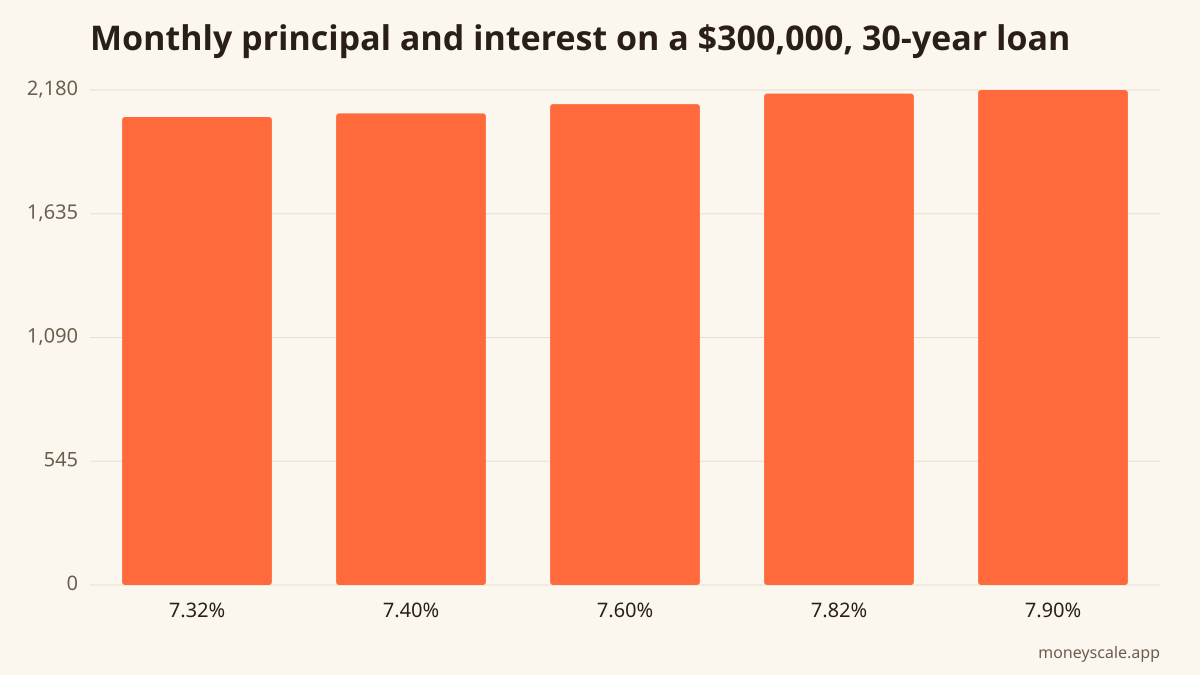
This table shows monthly principal and interest on the same $300,000, 30-year loan at rates from the 7.32% average up to 7.90%.
| Rate (%) | Monthly principal and interest ($) | Extra vs. 7.32% average ($/month) |
|---|---|---|
| 7.32 | 2,061 | 0 |
| 7.40 | 2,077 | 16 |
| 7.60 | 2,118 | 57 |
| 7.82 | 2,164 | 103 |
| 7.90 | 2,180 | 119 |
This week's 8-basis-point drop (a basis point is one-hundredth of a percentage point) saves $16 a month, less than one-sixth of the $103 a half-point-higher quote adds. These figures leave out property tax, homeowners insurance, and mortgage insurance, which sit on top of principal and interest.
Why is my mortgage rate higher than the average?
Fannie Mae and Freddie Mac charge loan-level price adjustments (LLPAs), upfront fees based on credit score and loan size relative to home value, on most conventional loans. Lenders often fold those fees into the rate, which is one reason two buyers can get different quotes on the same day.
Credit score. LLPAs rise as scores fall below the top tiers. A borrower at 680 and a borrower at 780 can see different rates on an identical house and loan amount.
Down payment. Loan-to-value (LTV) ratio is the loan balance divided by the home's value. Under 20% down, LTV tops 80%. LTV is one of the factors behind LLPAs, and a loan above 80% LTV usually requires private mortgage insurance (PMI), coverage that protects the lender.
Discount points. The Federal Reserve Board's consumer guide to mortgage refinancings defines one point as 1% of the loan amount. That comes to $3,000 on $300,000, paid upfront for a lower rate. A zero-point quote from one lender and a one-point quote from another aren't comparable until the points match.
Loan type. Federal Housing Administration (FHA) loans, Department of Veterans Affairs (VA) loans, and jumbo loans, which exceed the conforming limit, sit outside the survey entirely. A quote on any of them has no direct counterpart in the 7.32% average.
Loan purpose and property. Refinances are excluded from the purchase-only average, and cash-out refinances, which borrow extra against home equity, carry higher LLPAs. Second homes and investment properties also price above a primary residence.
Lock timing. A rate lock is a lender's promise to hold your rate for a set period, commonly 30 to 60 days. Your quote reflects the day it was issued and the lock length, while the PMMS blends a full week of applications. Longer locks generally cost more.
Is the APR on my Loan Estimate the rate to compare?
A Loan Estimate is a three-page form a lender must send within three business days of your application. The Consumer Financial Protection Bureau (CFPB) walks through each line in its Loan Estimate explainer. Page 1 shows the interest rate, also called the note rate, and whether it's locked. Page 2 lists any points under origination charges, and page 3 shows the annual percentage rate (APR), a yearly cost figure that includes lender fees.
Because APR folds lender fees into one yearly figure, it sits above the note rate on any loan that carries fees. The PMMS average leaves points and fees out, and Freddie Mac stopped publishing them alongside the rate in November 2022. Holding a page 3 APR against the 7.32% headline overstates your gap, because the APR includes costs the survey number doesn't.
A like-for-like check pairs page 1's rate with the weekly average. APR is built for a different job, comparing two lenders' offers on the same loan amount and term.
How can I tell if my quote is in a normal range?
The CFPB's Explore Interest Rates tool shows ranges of rates for a specific borrower profile instead of one national figure. With a 700 score and 10% down, a range matched to that profile is a closer benchmark than a survey built on 20% down and excellent credit.
Freddie Mac's next PMMS release is due Thursday, Oct. 29, 2026, at noon ET. At this rate level, a week-to-week move of 0.08 percentage point shifts Maya's payment by about $16. The half-point gap between her file and the benchmark shifts it by about $103. Plug your quoted rate and the Oct. 29 average into the mortgage payment calculator to see that monthly gap in dollars on your own loan amount.
Run your numbers
Plug your own figures into the Mortgage Payment calculator and see your specific outcome.
Open Mortgage PaymentSources
- Freddie Mac, Primary Mortgage Market Survey (Oct. 22, 2026 release and methodology notes)
- Consumer Financial Protection Bureau, Explore Interest Rates
- Consumer Financial Protection Bureau, Loan Estimate explainer
- Federal Reserve Bank of St. Louis, FRED series MORTGAGE30US
- Federal Reserve Board, A Consumer's Guide to Mortgage Refinancings
Related reads
Does the Fed Control Mortgage Rates? What Changes and What Doesn't
The Fed sets the federal funds rate, which moves credit cards, HELOCs, and savings yields. The 30-year fixed mortgage follows the 10-year Treasury. Here is the mechanical difference.
Read it400k Mortgage Monthly Payment at 7%: Full Cost
The 400k mortgage monthly payment at 7% on a 30-year fixed: $2,129 principal and interest, about $2,646 all-in with taxes and insurance.
Read itPMI Explained: What Private Mortgage Insurance Costs and When It Cancels
Private mortgage insurance protects your lender, not you — and you pay for it when you put down less than 20%. Here's what it costs, the federal law that forces it to cancel, and how to get it off your statement as early as possible.
Read itWill a Raise Put Me in a Higher Tax Bracket? The $5,000 Math
A raise into the 22% bracket taxes only dollars above the line, per 2026 IRS brackets. See how a $5,000 raise turns into $3,767.50 of take-home pay.
Read it
Money Scale Weekly
Money Scale Weekly — one chart, one idea, every week.
A short, plain-English read on saving, investing and compounding, with the numbers run for you. Free.
Free. One email a week. No spam — unsubscribe in one click.
Money Scale is free to read and free to use — no paywall, no account, no selling your data. Hosting and research still cost money, so if this was worth your time you're welcome to buy us a coffee. Never required.