Minimum Wage Goes Up July 1, 2026: Turning Hourly Into Annual Pay
Oregon, Alaska, DC and 20+ local areas reset their minimum wage on July 1, 2026. Here are the new hourly rates and the math to convert any rate into weekly, monthly, and annual gross pay.

Written with AI assistance; every figure is checked against our calculators and primary sources, and reviewed by Ethan Ginsberg before publishing.
The bottom line
A full-time worker at Oregon's new $16.80 Portland Metro minimum earns $34,944 a year before taxes (16.80 × 2,080).
On Wednesday, July 1, 2026, several places reset their minimum wage. Oregon's three tiers rise to $16.80 (Portland Metro), $15.55 (standard), and $14.55 (nonurban) per Oregon BOLI. Alaska moves to $14.00. The federal floor stays $7.25, unchanged since 2009. To get gross annual pay, multiply the hourly rate by 2,080.
Which minimum wages change on July 1, 2026?
Most states that raise their minimum wage do it on January 1. A smaller group adjusts mid-year, on July 1, and 2026 is no different. "Gross pay" below means pay before any taxes or deductions come out.
The Oregon Bureau of Labor and Industries (BOLI) sets three rates indexed to inflation, recalculated each year using the Consumer Price Index (CPI), the federal government's measure of how much prices change. Effective July 1, 2026, Oregon's rates are:
| Oregon region (per Oregon BOLI) | Rate effective July 1, 2026 |
|---|---|
| Portland Metro | $16.80/hr |
| Standard (most counties) | $15.55/hr |
| Nonurban counties | $14.55/hr |
Alaska's rate rises to $14.00/hr on July 1, 2026, the second step of a scheduled phase-in tracked by the Alaska Department of Labor and Workforce Development. The District of Columbia also adjusts its rate every July 1 using CPI; its rate was $17.95/hr effective July 1, 2025, rising to $18.40/hr on July 1, 2026, per the DC Department of Employment Services. More than 20 city and county jurisdictions run their own July 1 resets as well.
What is the federal minimum wage in 2026?
The federal minimum wage is $7.25 per hour. The U.S. Department of Labor lists this rate as unchanged since July 24, 2009. When a state or local minimum is higher than the federal floor, the higher rate applies to covered workers in that area. The DOL's State Minimum Wage Laws page is the federal index of each state's current rate.
How do you convert an hourly wage to annual pay?
There are two standard formulas. Use the one that matches your schedule.
Full-time (the 2,080 shortcut). A full-time schedule is 40 hours a week for 52 weeks, which is 2,080 hours a year (40 × 52). So gross annual pay is:
hourly rate × 2,080
Any schedule (the exact version). If you don't work 40 hours, use your actual weekly hours:
hourly rate × hours per week × 52
Weekly pay is the hourly rate × hours worked that week. Monthly pay is the annual figure divided by 12. Plug any rate into the companion tool at /tools/salary-to-hourly to run it both directions.
What do the new July 1 rates work out to per year?
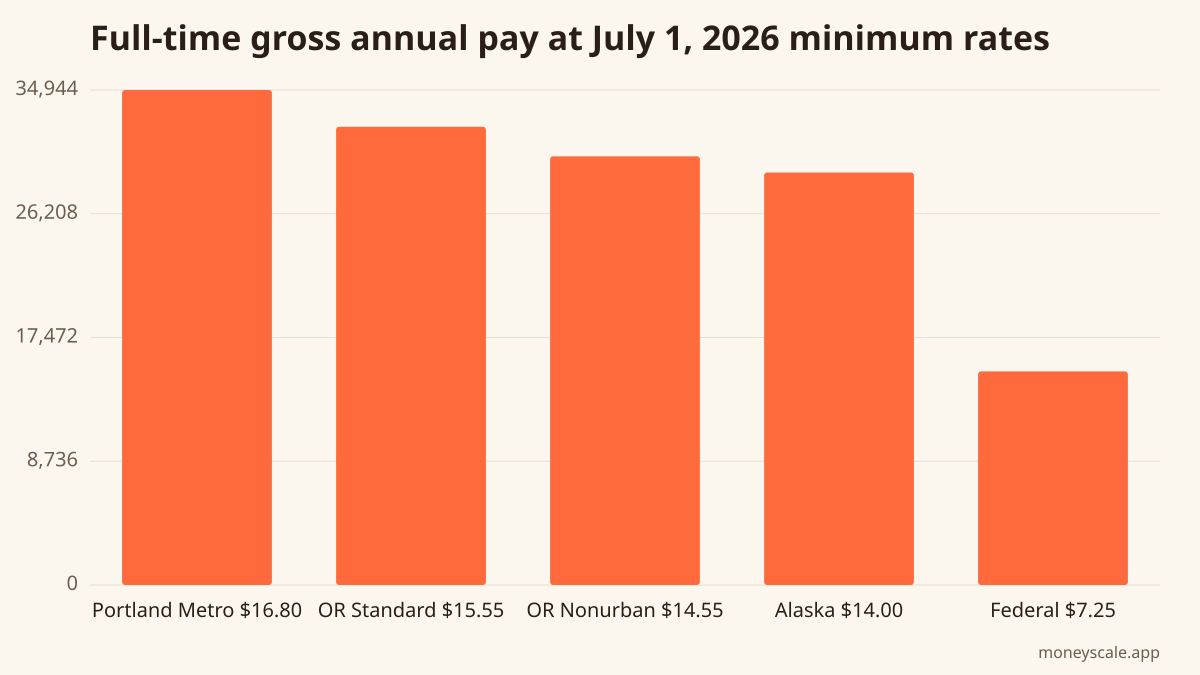
Using the full-time formula (rate × 2,080), here is the gross annual pay at each new rate, with the $7.25 federal floor for comparison:
| Rate (effective July 1, 2026) | Hourly | Weekly (40 hrs) | Annual (2,080 hrs) |
|---|---|---|---|
| Portland Metro | $16.80 | $672 | $34,944 |
| Oregon Standard | $15.55 | $622 | $32,344 |
| Oregon Nonurban | $14.55 | $582 | $30,264 |
| Alaska | $14.00 | $560 | $29,120 |
| Federal floor | $7.25 | $290 | $15,080 |
How does part-time math change the result?
The 2,080 shortcut assumes 40 hours every week. Fewer hours change the total in direct proportion. Take Oregon's $15.55 standard rate at 25 hours a week: 15.55 × 25 × 52 = $20,215 a year gross. At 30 hours: 15.55 × 30 × 52 = $24,258. The hourly rate is the same; only the hours move the annual number.
Monthly pay from the full-time figure is the annual divided by 12. At Portland Metro's $16.80, that's $34,944 ÷ 12 = $2,912 a month gross.
What does this math leave out?
Every figure above is gross pay, the amount before federal income tax, Social Security and Medicare (FICA) withholding, state taxes, or any deductions come out. Take-home pay is lower and depends on filing status, withholding, and where you live. Overtime, tips, and unpaid weeks also change real-world totals. The formulas here answer one mechanical question: what a given hourly rate equals over a week, month, or year of scheduled hours.
To check your own number, take your new hourly rate, multiply by your weekly hours, multiply by 52, and compare it against the calculator at /tools/salary-to-hourly.
Run your numbers
Plug your own figures into the Salary to Hourly calculator and see your specific outcome.
Open Salary to HourlySources
Related reads
Student Loan Autopay Discount Jumps to 1% on July 1, 2026
The federal autopay interest-rate discount rises from 0.25 to a full 1 percentage point on July 1, 2026. Here's how it works, who qualifies, and what one point does to total interest.
Read itFederal Student Loan Interest Rates for 2026–27: How the July 1 Rate Is Set
The new fixed rates for federal Direct loans disbursed July 1, 2026–June 30, 2027, the Treasury-plus-add-on formula that sets them, and how one rate point changes a payment.
Read itER Travel Nurse Salary: What Emergency Room Contracts Pay in 2026
ER travel nurse salary typically runs about $2,000–$3,100 a week blended, higher during crisis demand. Here's how emergency room pay breaks down by region and why it swings.
Read itFAFSA Deadline Is June 30: Federal vs. State Aid Deadlines
The 2025-26 FAFSA federal deadline lands at 11:59 p.m. Central on June 30, 2026. Here's how it differs from state and college cutoffs.
Read it
Money Scale Weekly
Read another one like this on Thursday?
We send one short, sourced money read per week. Tied to salary to hourly and the other Money Scale pillars. Free, no spam, one click to unsubscribe.
Drop your email and you're in. We send one short read on Thursday — and nothing else without your asking.
Money Scale is free to read and free to use — no paywall, no account, no selling your data. Hosting and research still cost money, so if this was worth your time you're welcome to buy us a coffee. Never required.