401(k) Contribution Limit 2027: What Percent Maxes $25,500
The 2027 401(k) limit computes to $25,500, up from $24,500, pending IRS announcement. That's $980.77 per biweekly check, or 21.25% of a $120,000 salary.

Written with AI assistance; every figure is checked against our calculators and primary sources, and reviewed by Ethan Ginsberg before publishing.
The bottom line
Maxing out the computed 2027 401(k) limit of $25,500 takes $980.77 per biweekly paycheck, or 17% of a $150,000 salary.
The 401(k) contribution limit for 2027 computes to $25,500 under the tax code's inflation formula, pending the IRS's official announcement. On a biweekly payroll, maxing it out takes $980.77 per paycheck, up from $942.31 under this year's limit. As a percentage of pay, the answer depends only on your salary.
Per-paycheck dollars and salary percentages for $25,500
A $25,500 limit divides into $980.77 per biweekly paycheck, $1,062.50 semimonthly, and $2,125 monthly. All 2027 figures are computed and await the IRS's official announcement. The 2026 figures are official: the IRS's Notice 2025-67, released Nov. 13, 2025, set the 2026 elective deferral limit (the cap on what you put in from your paychecks) at $24,500.
This table shows the per-check dollar amount needed to hit each year's limit on the four common pay schedules.
| Pay schedule | Paychecks per year | 2026 limit, $24,500 ($ per check) | 2027 limit, $25,500, computed ($ per check) |
|---|---|---|---|
| Weekly | 52 | $471.15 | $490.38 |
| Biweekly | 26 | $942.31 | $980.77 |
| Semimonthly | 24 | $1,020.83 | $1,062.50 |
| Monthly | 12 | $2,041.67 | $2,125.00 |
Monthly pay sees the largest per-check change: $83.33 more per paycheck in 2027 than in 2026.
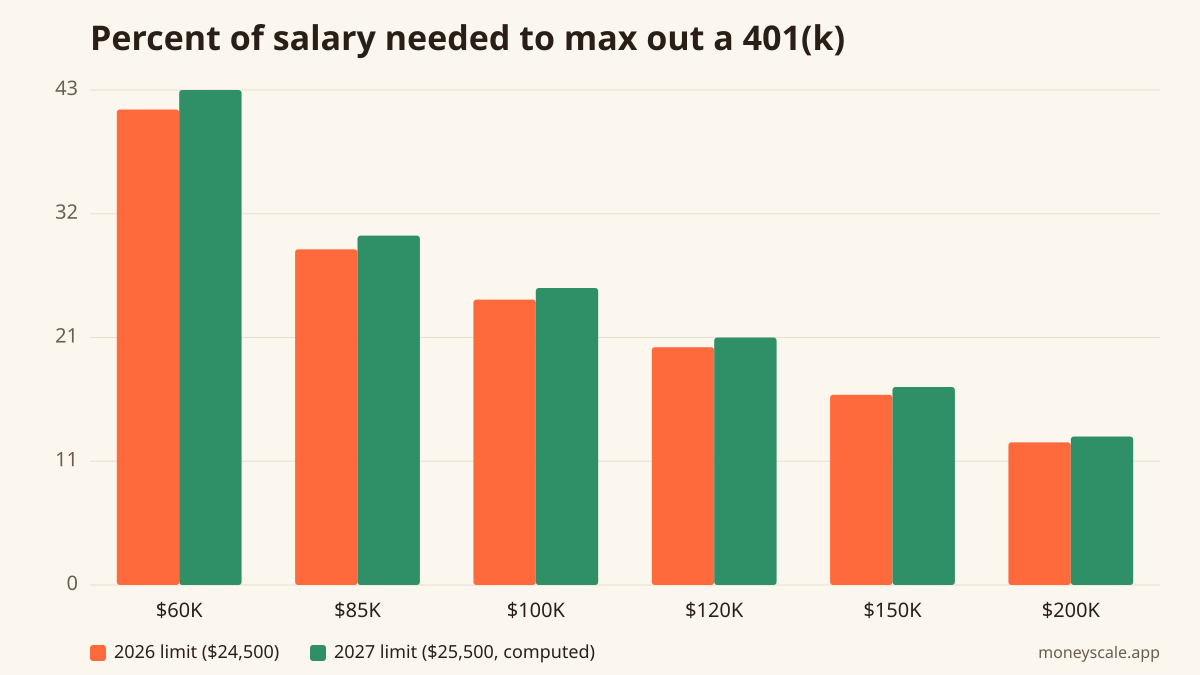
Your benefits portal asks for a percentage, though, and that number depends only on salary. Pay frequency drops out because the limit and your pay get split the same number of ways. This table gives the percentage of gross salary that maxes out each year's limit.
| Annual salary ($) | 2026 limit, $24,500 (% of pay) | 2027 limit, $25,500, computed (% of pay) |
|---|---|---|
| $60,000 | 40.83% | 42.5% |
| $85,000 | 28.82% | 30% |
| $100,000 | 24.5% | 25.5% |
| $120,000 | 20.42% | 21.25% |
| $150,000 | 16.33% | 17% |
| $200,000 | 12.25% | 12.75% |
At $60,000, maxing out takes 42.5% of gross pay, which can exceed the maximum deferral rate some plans write into their rules.
Say Marcus earns $120,000 and is paid biweekly, so each gross check is $4,615.38. Hitting $25,500 evenly takes $980.77 per check, or 21.25%. His portal accepts only whole percentages. At 21%, he puts in $969.23 per check and ends 2027 at about $25,200, roughly $300 under the limit. At 22%, he puts in $1,015.38 per check, reaches $25,384.50 after 25 paychecks, and his 26th check takes only the remaining $115.50.
Run your own salary and pay schedule through the 401(k) contribution calculator to see where a whole-percent election lands.
How is the 2027 401(k) limit calculated?
Section 402(g)(4) of the Internal Revenue Code (IRC) ties the elective deferral limit to the cost-of-living adjustment in IRC Section 415(d). The result is then rounded down to the next lower multiple of $500. That adjustment compares the average Consumer Price Index for All Urban Consumers (CPI-U, the main U.S. inflation index) for July through September against the same quarter in a fixed base year.
Monthly CPI-U figures come from the Bureau of Labor Statistics' Consumer Price Index program, whose September 2026 report completed the quarter the formula uses. The Federal Reserve Bank of St. Louis carries the same unadjusted series in its Federal Reserve Economic Data (FRED) database, labeled CPIAUCNS, for anyone rerunning the average.
This table compares the official 2026 limits with the 2027 figures the formula produces, including catch-up contributions, an extra allowance above the base limit for workers 50 and older.
| Limit | 2026, official ($) | 2027, computed, pending IRS announcement ($) |
|---|---|---|
| Elective deferral | $24,500 | $25,500 |
| Catch-up, age 50 and older | $8,000 | $8,500 |
| Catch-up, age 60 to 63 | $11,250 | Not yet published |
| Total annual additions (you plus employer) | $72,000 | $75,000 |
The age 60 to 63 row is the one the deferral formula doesn't settle, because that catch-up follows its own indexing rule and the IRS hasn't published its 2027 amount.
Because of the round-down, the limit moves only in $500 steps. The unrounded figure has to clear $25,500 before the limit rises to it, so a mild inflation year can leave the limit flat. Steps can also stack: the 2025 limit of $23,500 rose $1,000 to reach $24,500 for 2026.
Catch-up limits at 50 and at 60 to 63
If you're 50 or older by Dec. 31, 2027, the computed $8,500 catch-up lifts your personal cap to $34,000. Biweekly, that's $1,307.69 per check, or 28.33% of a $120,000 salary. The IRS's page on catch-up contributions ties eligibility to being age 50 or over at the end of the calendar year.
Ages 60 through 63 get a larger catch-up under the Setting Every Community Up for Retirement Enhancement (SECURE) 2.0 Act. For 2026 it's $11,250, for a total personal cap of $35,750. At 64, the regular age-50 catch-up applies again. Catch-ups sit on top of the total-additions cap, so they don't count against the $75,000 computed for 2027.
Starting in 2026, higher earners must make catch-ups as Roth contributions, which go in after tax. Notice 2025-67 puts the 2026 threshold at $150,000 of Federal Insurance Contributions Act (FICA) wages from that employer in 2025. That threshold is indexed, so the cutoff for 2027 catch-ups, based on 2026 wages, arrives with the IRS's next release. Your base $25,500 can still go in pretax or Roth, depending on what the plan offers.
Does maxing out early cost you the employer match?
It can if your employer matches per paycheck and the plan has no true-up, a year-end deposit that makes up match lost by maxing out early. Say Priya earns $150,000, paid biweekly, so each gross check is $5,769.23. Her plan matches 50% of the first 6% of pay each pay period, which tops out at 3% of salary, or $4,500 a year.
At 17%, she contributes $980.77 every check and receives a $173.08 match on all 26 checks, for $4,500. At 34%, she contributes $1,961.54 per check and hits $25,500 after 13 paychecks. Her contributions stop, the match stops with them, and she collects $2,250 while missing the other $2,250.
Plans with a true-up calculate the match on full-year pay and deposit the shortfall after year end. Your summary plan description, the plan's official rule summary, says which kind of plan you're in, and the mechanics of match formulas are laid out in how employer matching formulas work.
Bonuses, raises, and job changes
A percentage election usually applies to every dollar your plan counts as compensation, including bonuses if the plan's definition covers them. If Marcus elects 21.25% and gets a $10,000 bonus, the bonus pulls in $2,125. He reaches $25,500 partway through his 24th paycheck and contributes nothing on the last two checks.
Raises work the same way. A mid-year bump keeps the same percentage but applies it to bigger checks, so the year's total climbs past what the original rate would have produced.
Switching jobs adds a separate risk. The $25,500 limit is per person across every 401(k) and 403(b), the similar plan for schools and nonprofits, that you contribute to. A new employer's plan doesn't know what went into the old one.
When will the IRS confirm the 2027 numbers?
The IRS usually publishes the next year's limits between late October and mid-November, and last year's release, Notice 2025-67, came out Nov. 13, 2025. If the official 2027 figure is $25,500, every paycheck amount above holds as written. A different figure changes only the number being divided.
Salary moves the result more than any other input: the same limit is 30% of $85,000 and 17% of $150,000. Plans set their own rules on how often you can change a deferral rate, and the summary plan description lists them. Enter your 2027 salary and pay schedule in the 401(k) contribution calculator to see the per-check dollar amount behind $25,500.
Run your numbers
Plug your own figures into the 401(k) Projection calculator and see your specific outcome.
Open 401(k) ProjectionSources
- IRS, COLA Increases for Dollar Limitations on Benefits and Contributions (Notice 2025-67)
- IRS, Retirement Topics: 401(k) and Profit-Sharing Plan Contribution Limits
- IRS, Retirement Topics: Catch-Up Contributions
- Bureau of Labor Statistics, Consumer Price Index
- Federal Reserve Bank of St. Louis, FRED: CPI-U, Not Seasonally Adjusted (CPIAUCNS)
Related reads
Mid-2026 Check: Are You on Pace to Max Out Your 401(k)?
A mechanical, no-advice walkthrough of the math that tells you whether your current 401(k) deferral hits the 2026 IRS cap by December 31.
Read itSaver's Match 2027: Who Gets Up to $1,000 for Retirement
The Saver's Match starts with 2027 contributions: 50% of up to $2,000 you save, or $1,000 a year. It goes into a retirement account, not your tax refund.
Read itSocial Security Wage Base 2027: Tax Stops at $192,300
The 2027 Social Security wage base is $192,300, up from $184,500 in 2026. See when the 6.2% tax stops and how two-job workers get excess tax back.
Read itStudent Loan Autopay Discount Jumps to 1% on July 1, 2026
The federal autopay interest-rate discount rises from 0.25 to a full 1 percentage point on July 1, 2026. Here's how it works, who qualifies, and what one point does to total interest.
Read it
Money Scale Weekly
Money Scale Weekly — one chart, one idea, every week.
A short, plain-English read on saving, investing and compounding, with the numbers run for you. Free.
Free. One email a week. No spam — unsubscribe in one click.
Money Scale is free to read and free to use — no paywall, no account, no selling your data. Hosting and research still cost money, so if this was worth your time you're welcome to buy us a coffee. Never required.